Case erecting, product-matrix packing, and robotic palletizing in one coordinated compact cell
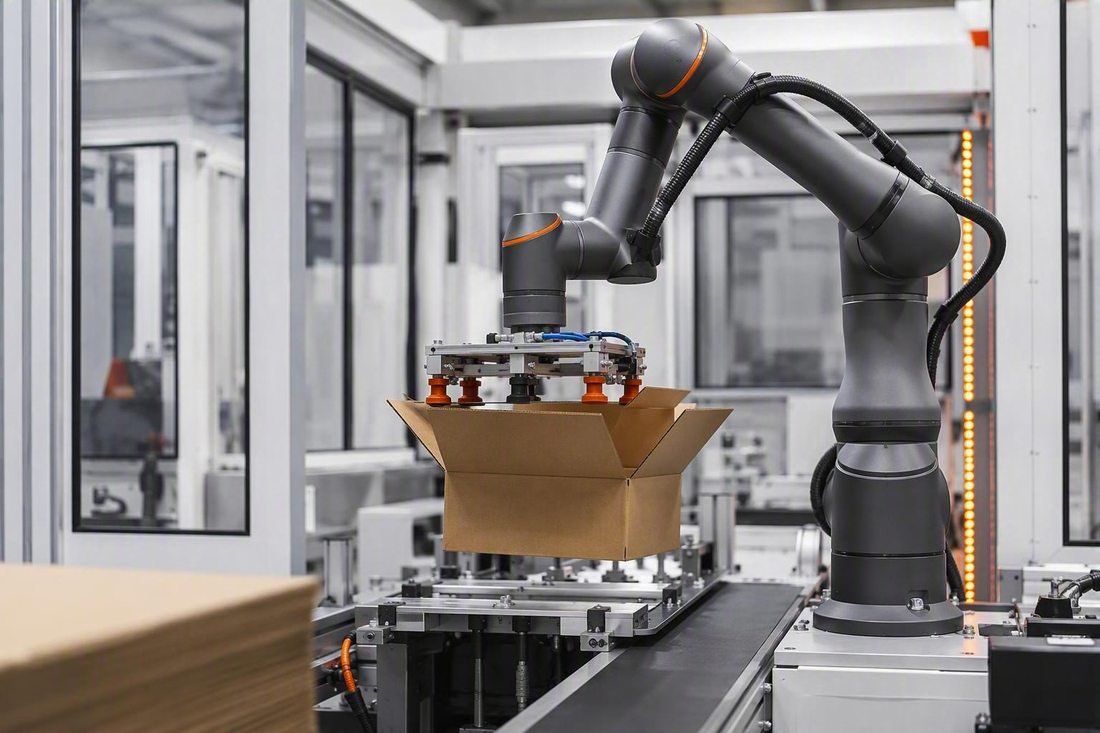
The brief: connect eight packaging stages -- from blank loading to palletizing -- in one compact cell, without dividing the work across separate, disconnected machines.
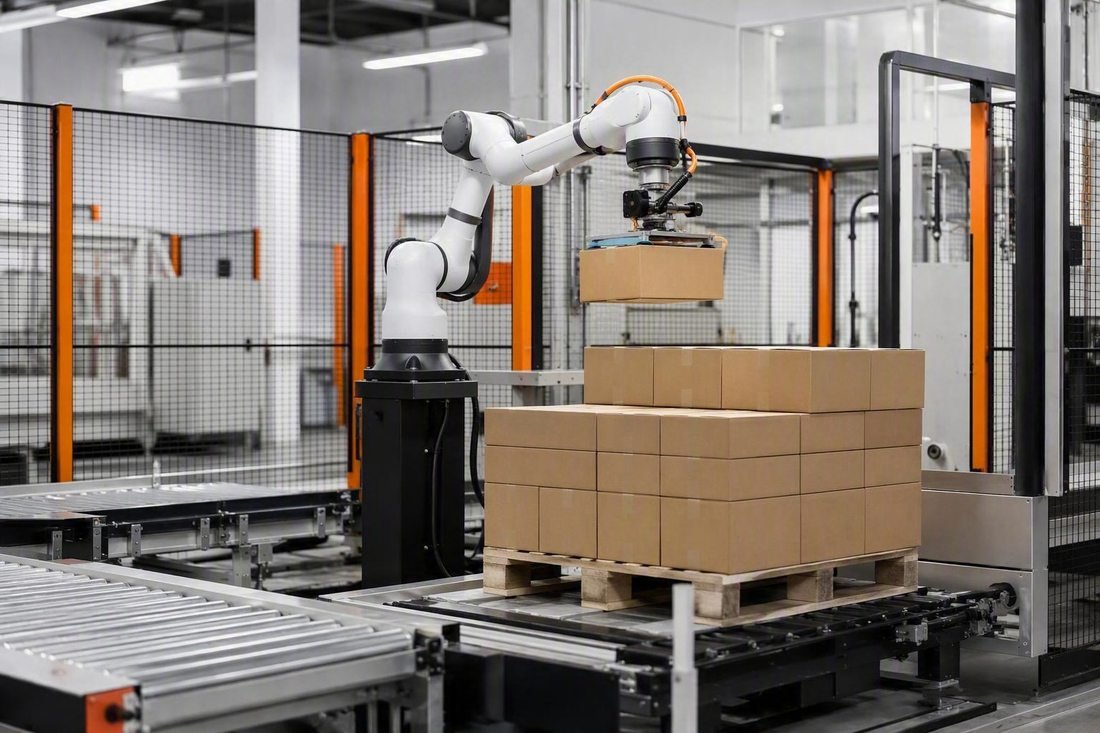
Cobot 1 picks a carton blank, loads the forming unit, forms and squares and seals the bottom, picks the aligned product matrix, and lowers it into the open case. A controlled handoff transfers the packed case toward Cobot 2, which detects the closed case, calculates the target pallet position, and places it layer by layer.
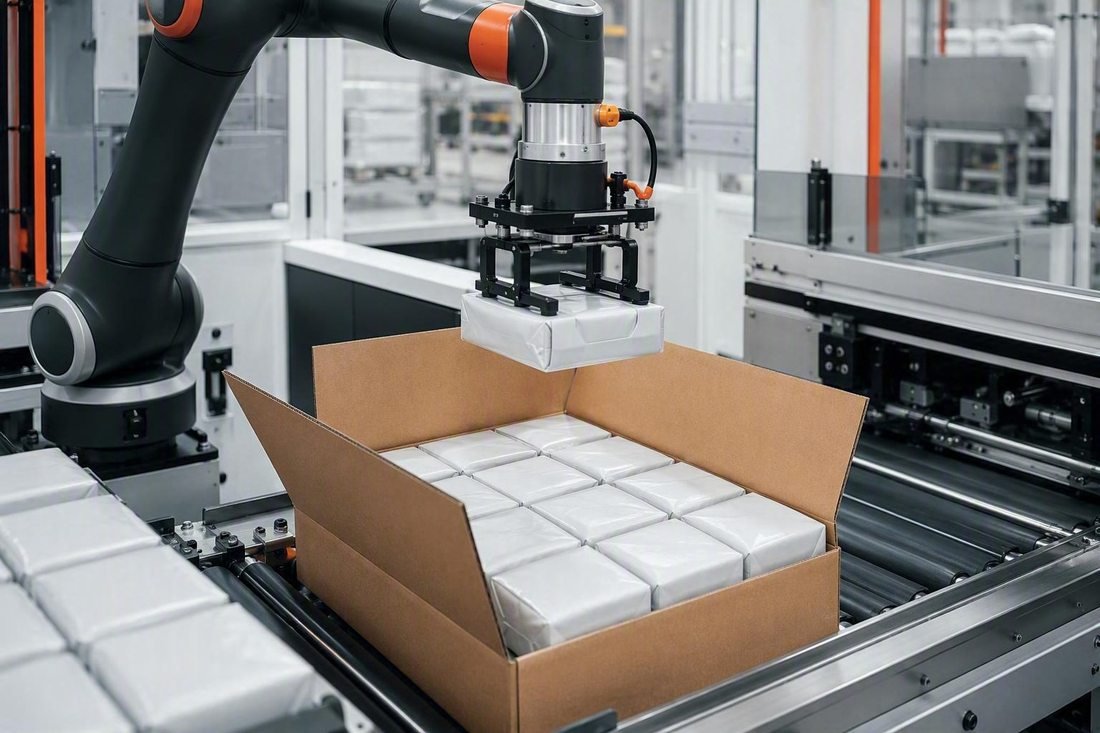
A preliminary straight-stack calculation on a 1000 x 1200 mm pallet with a 150 x 100 mm case footprint yields 72 cases per layer -- 576 cases across 8 layers. Straight stack maximizes simple density; alternating orientation changes layer-to-layer for stability; brick or interlocking patterns improve stack engagement further.
Pickup position, product matrix position, case loading position, pallet pattern, layer height, case count, and robot speed all live in software. Changing product or format is a recipe update, not a mechanical rebuild -- across a proposed 5-25 kg payload range and matrix formats such as 3x4, 4x5, or 5x6.
Flexible: multiple formats served through recipes, not retooling
Compact: an integrated secondary-packaging cell in one footprint
Ergonomic: removes repetitive lifting and stacking from the line
Scalable: add checkweighing, vision, pallet handling, or stretch-wrap as the line grows
Concept capability presentation — commercial design follows application validation and detailed engineering. Confirm case weights, surfaces, throughput, gripper trials, and safety concept before release.